A Free Preview
The Foreword, the full table of contents, and the opening of Chapter One.
Right now, you are hurtling through the Cosmos, racing at over 1.9 million miles per hour. Earth has suffered more than any other story in human history, super volcanoes blotting out the sun for decades, asteroids smashing continents, ice ages swallowing half the world in quiet darkness. Yet through terror and silence, Earth never stopped turning.
This is the real story of Earth, raw and untamed. A narrative that diverges sharply from the orderly version found in textbooks or the common timeline that begins with Mesopotamia, neglecting deeper, older enigmas. To clarify its focus, this book begins by posing critical questions: How do geological and archaeological evidence challenge established historical timelines? What insights do ancient structures and recurring flood myths from disparate cultures provide regarding our collective history? The answers are inscribed in stone, manifesting as features across mountain ranges, embodied in ancient monuments admired by modern engineers, and reflected in flood narratives that resonate throughout the world's civilizations.
This book promises to let evidence guide the narrative, putting discovery in your hands.
You won't find YouTube theories or Reddit speculation here. Nor will you find the kind of wild guesses that make real research look bad. Instead, these pages offer physical evidence: geological records, precise engineering measurements, astronomical alignments that don't fit their assigned eras, genetic oddities, and ancient manuscripts translated from real artifacts. The patterns are so consistent across thousands of miles and years. At a certain point, coincidence no longer makes sense.
You'll stand at the base of structures built from stones over a thousand tons, asking the same question as modern engineers: how was this possible? You'll see sites dated to when humans supposedly lived in caves and wonder whether evidence or textbooks are wrong. You'll read flood stories from cultures that never met yet tell the same tale. You'll learn that 12,800 years ago, something struck Earth, resetting civilization, with geological evidence visible for decades.
Some people desperately hope you never learn these truths.
Some institutions cling desperately to an unchanged timeline. Careers teeter on the edge of sanctioned stories. Organizations erase inconvenient artifacts in silence. Sometimes, merely asking the wrong question can destroy a future. This book exposes them, lays bare the patterns, and dares you to judge what it all means.
Earthly Enigmas does not prescribe what you should believe. It presents the evidence, what has been discovered, documented, and unearthed. The book features an interactive globe tool that enables you to virtually explore the locations discussed, examine alignments, access relevant data, and engage directly with the evidence. By organizing these resources in a user-friendly format, the book encourages you to reach your own informed conclusions.
“The evidence has always called out, daring us to really see. Are you ready to face what's been hiding in plain sight?”
Six parts. Nineteen chapters. One question that won't let go.
Part One — The Cosmic Perspective
- 1.You Are Here
- 2.This Rock Has Been Through Hell
Part Two — The Golden Age
- 3.The Impossible Structures
- 4.They're Older Than We're Told
- 5.The Global Network
- 6.Messages Written for the Sky
- 7.The Anunnaki Connection
Part Three — The Great Reset
- 8.12,800 Years Ago
- 9.The Flood Stories
- 10.What Was Lost
- 11.The Survivors
Part Four — They're Still Here
- 12.Sacred Geometry Returns
- 13.The Oregon Message
- 14.The Pattern Continues
Part Five — The Cover-Up
- 15.Forbidden Zones
- 16.The Knowledge Suppressors
- 17.Why It Stays Hidden
Part Six — Where We Are Now
- 18.The Current State
- 19.Where Are We Going?
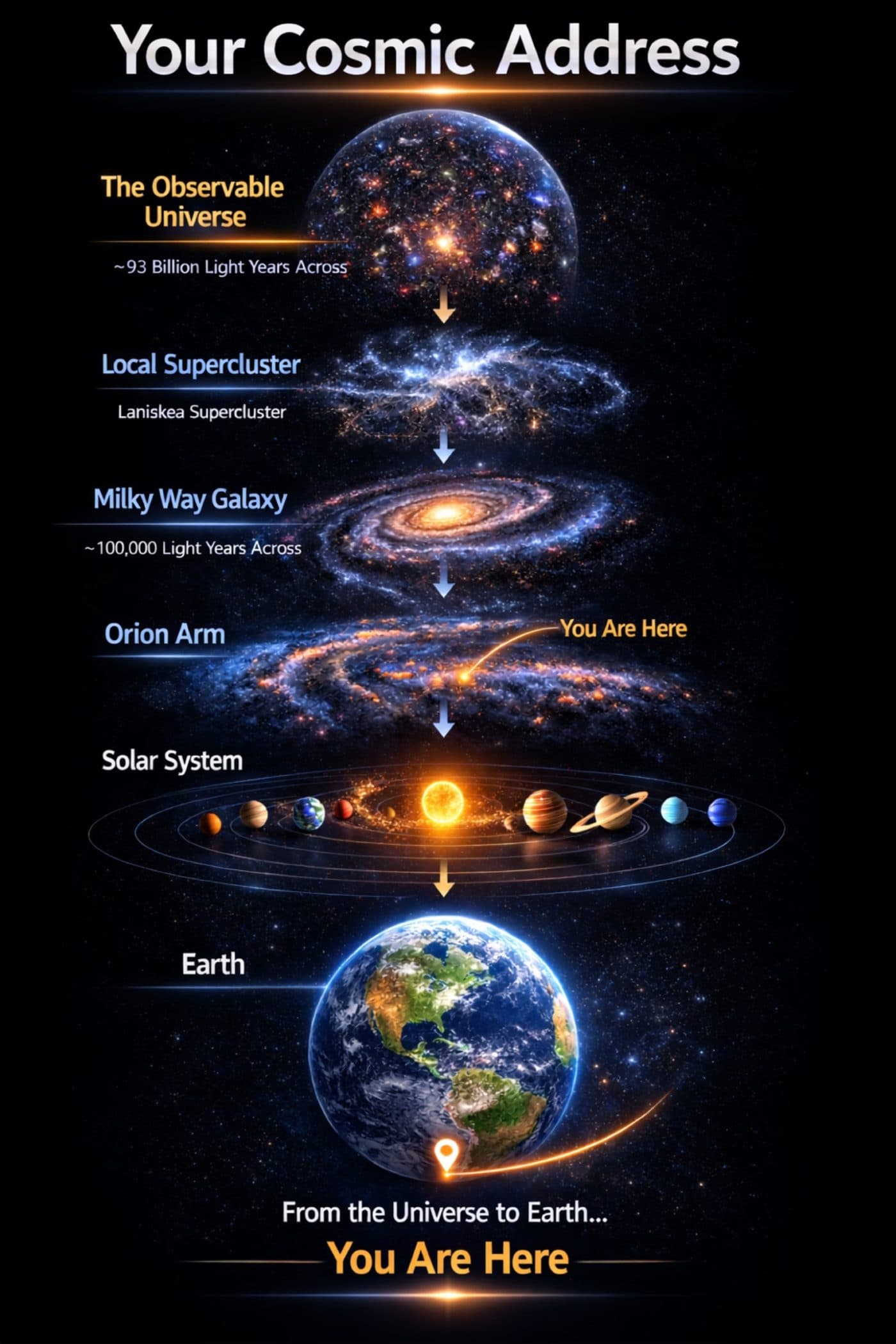
Looking up at the night sky full of stars or a full moon still fills my mind with awe and wonder. For a moment, let go of your address, your country, your continent. Zoom out. Way out.
The observable universe is 93 billion light-years across. Inside that sphere of space and time, there are an estimated 2 trillion galaxies. Each galaxy holds hundreds of billions of stars. The Milky Way alone (your galaxy, the one you live in) contains somewhere between 200 and 400 billion of them. Around a great many of those stars, there are planets.
The math that presents itself is crazy to consider. There are more stars in the observable universe than grains of sand on every beach and desert on Earth, combined. The universe is not mostly empty. The universe is mostly full, in ways our minds were not built to comprehend.
Now find yourself in it.
Our solar system sits near the edge of one of the Milky Way's outer spiral arms, in the Orion Spur. A relatively quiet region of the galaxy. We are, cosmically speaking, in the suburbs. The Sun is one star among hundreds of billions in a galaxy that takes 100,000 light-years to cross, and our solar system takes 240 million years just to complete a single orbit around the galactic center.
We are here on “the pale blue dot”, in the outer arm of an average spiral galaxy. In a universe so vast that the word "vast" doesn't come close to doing the job.
The Math of Time
The universe is 13.8 billion years old. Earth formed approximately 4.54 billion years ago, about one-third the age of the universe. To put that in perspective, by the time our planet coalesced from a swirling disk of dust and gas around a young sun, the universe had already been running for more than 9 billion years.
Nine billion years. Think about what that means.
Generations of stars had already lived and died before Earth existed…
They are still there. You can walk up to them, put your hand on them, and feel the problem with your own fingers.
The stones are too big, too precise, and too heavy. They were cut from quarries that are too far away. The stones were assembled in ways that modern engineering teams have studied and, in several documented cases, admitted they cannot fully explain.
This is not a claim from alternative history forums. Archaeologists, engineers, geologists, and materials scientists have measured, analyzed, and published their findings in peer-reviewed journals. The structures exist. The specifications are measurable. The gap between the requirements and what we know of the builders widens, not narrows, the more carefully you look.
The Problem with the Pyramids
The Great Pyramid of Giza is not mysterious because it is old. It is mysterious because of what it is.
Start with the specifications. The base covers 13.1 acres. The original height was 146.5 meters (approximately 481 feet). It was the tallest structure in the world for 3,800 years, a record that held until the completion of Lincoln Cathedral in England in 1311. It contains an estimated 2.3 million individual stone blocks. The average block weighs approximately 2.5 tons. The heaviest known blocks, located in the King's Chamber ceiling, weigh between 25 and 80 tons. The granite used for interior chambers was quarried at Aswan, 800 kilometers to the south.
Now the precision. The base of the Great Pyramid is level to within 2.1 centimeters across all four sides, across 230 meters of ground. The four sides are oriented to the cardinal points with an average deviation of 3 minutes and 6 seconds of arc. For comparison, the Meridian Building at the Royal Observatory in Greenwich, purpose-built in 1851 to establish the prime meridian, was aligned to within 3 minutes and 45 seconds of arc. The ancient structure is more precisely aligned than the modern one, built specifically for alignment.
Most casing stones were stripped for use as building material during the medieval period. Surveyors in the 19th and 20th centuries measured the finished stones' tolerance to be less than 1 millimeter across faces exceeding a square meter each. Joints were so tight that a knife blade could not fit between them. Some mortar in the joints has been analyzed; it is not conventional mortar but a fine slurry of gypsum, sand, and water. Its function appears to be both lubricant and adhesive, allowing enormous stones to slide into exact position. In some locations, the mortar has held for 4,500 years.
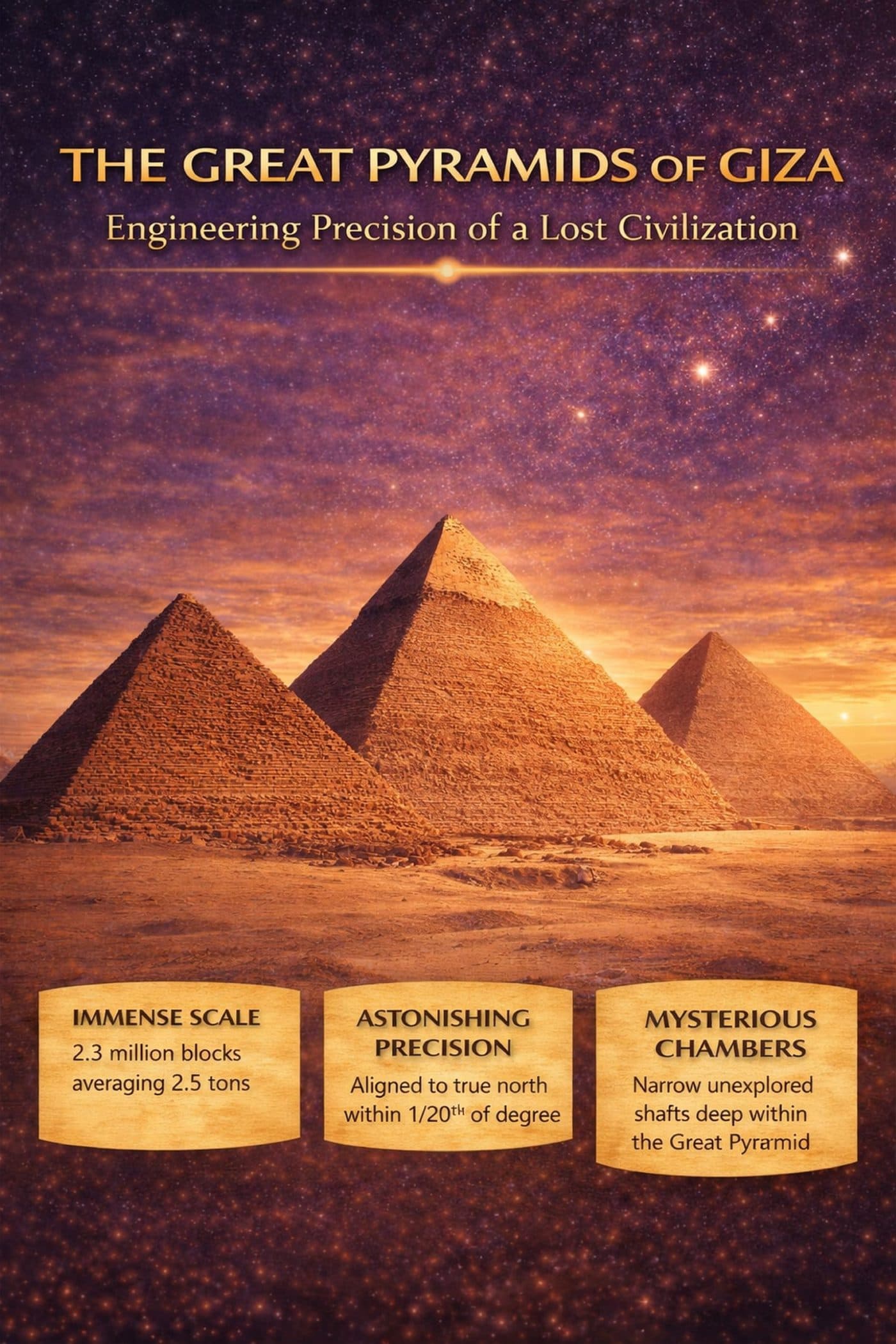
The internal architecture presents its own questions. The shafts in the King's and Queen's Chambers do not ventilate the pyramid in any conventional sense, as they are too narrow, and two do not reach the exterior. In 1993, engineer Rudolf Gantenbrink, on behalf of the German Archaeological Institute, conducted a robotic survey. He found that the southern shaft of the Queen's Chamber ends at a small stone door with copper fittings, 65 meters from the chamber. In 2002, another robotic mission drilled through the door and found a small chamber and another door beyond it. What, if anything, lies behind the second door remains unknown. No authorization has been given to continue the investigation.
None of this proves an exotic origin for the pyramid. What it does prove is that its construction required a level of logistical organization, geometric knowledge, and technical precision that, on our conventional timeline, should not have existed at the scale demonstrated in 2560 BCE.
The mainstream explanation of organized labor, copper tools, sledges, and ramps has been modeled and argued for decades and is a legitimate framework. Egyptologists have found workers' villages…
Keep Reading
This is where the sample ends — and the real journey begins. Earthly Enigmas runs across six parts and nineteen chapters, paired with an interactive globe to explore every site first-hand.
Explore the Enigmas →